
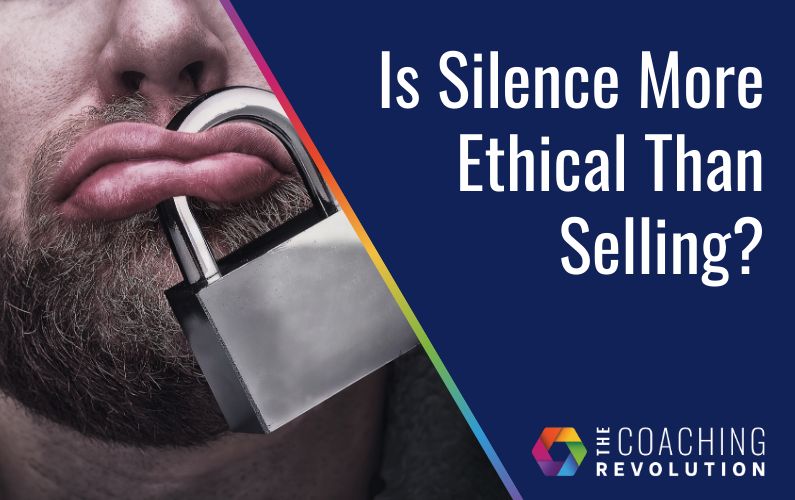
Many of us have convinced ourselves that staying quiet is the ethical choice. We tell ourselves that we don’t want to be pushy or salesy, that good coaching should speak for itself, that if we just wait, the right clients will find us. It sounds noble, but I suspect it’s often a smokescreen for something else entirely.
The truth is that most coaches who stay invisible aren’t making a principled stand against aggressive sales or marketing. We’re procrastinating, and the ethics story is a convenient way to make peace with a problem we can’t quite explain.
Why We Stay Invisible
There’s a lot of vague advice on client acquisition in our profession about showing up online, or even more unhelpfully, showing up authentically. The problem with this kind of guidance is that it’s completely unimplementable. What does showing up authentically actually mean? What are we supposed to say? How often? To whom? And where?
Procrastination thrives when three conditions are present – no clear goal, an unclear focus, and negative self-talk. The advice to show up authentically hits all three. When we’re not quite sure what to do or why we’re doing it, we become vulnerable to our mind monkeys, that internal chorus telling us we’ll be judged and found wanting. The result is either complete invisibility or content that’s been so heavily polished and over-edited that it says nothing at all, and it says it in coach-speak.
Coach-speak, is that sanitised, vague language that is laden with coaching jargon and feels safe because it can’t possibly offend anyone. The problem is that it can’t possibly interest anyone either.
The Cost of Being Invisible
The biggest problem that we face as coaches is that no one knows what we do, but they think they do and they’re wrong. Compare us to therapists for a moment. People understand what therapy is, which means they know when they might need the services of a therapist. That’s rarely the case for coaches. People don’t understand what coaching can help with, so they don’t look for a coach when they’re struggling.
When I ask coaches who their competition is, they invariably say other coaches, but this is rarely true. Our main competition is self-help books, podcasts and YouTube channels, because that’s where our potential clients are looking to find answers to their internal turmoil. They’re not searching for coaches because it doesn’t occur to them that a coach could help.
This means that the coach who shows up with vague coach-speak and sanitised content, whether in person or online, is simply not seen and I mean that literally. Potential clients will not see or engage with what we say because it means nothing to them. Their reticular activating system, the part of the brain that filters what we pay attention to, will disregard it as irrelevant. In order to be seen, we need to be relevant.
What Relevant Visibility Looks Like
Being relevant requires a tight focus, and there’s a lot of resistance to this in our profession. It feels like closing doors to potential clients when common sense tells us we should remain open to any and all opportunities. The problem is that common sense isn’t a marketing strategy, and effective, ethical client acquisition is counterintuitive.
The tighter we focus, the louder our voices become. When we speak to a specific group of people about a specific problem they’re experiencing, we get their reticular activating system to stop ignoring us and start registering what we’re saying. A coach who helps anyone who is navigating transitions is invisible to everyone. A coach who helps new managers in tech companies struggling with imposter syndrome (for example) becomes visible to exactly the people who need them.
This feels risky, but it’s the opposite of risky. Staying broad doesn’t keep doors open – it keeps us invisible.
The Real Ethical Problem
I think there’s something genuinely unethical about what’s happening in our profession, but it’s not what we tell ourselves. We have a fantastic skill that could benefit so many people, but instead of learning how to find clients, we continue to talk in coach-speak, fail to generate interest, and then conclude that either the coaching profession is saturated or that marketing simply doesn’t work.
Meanwhile, the people who could benefit from coaching are buying self-help books, listening to podcasts, and watching YouTube videos because they don’t know we exist. They’re struggling with problems we could help them solve, but they’ll never find us because we’ve convinced ourselves that visibility is somehow unseemly.
Staying silent isn’t the ethical high ground. It’s a failure to learn the skills that would allow us to help the people who need us. The ethics justification may make us feel better about our invisibility, but it doesn’t change the outcome – people who need coaching aren’t getting it, and we’re not building sustainable businesses.
An Opportunity
If you’d like to learn more about ethical client acquisition for coaches, why not schedule a call to hear more about how The Coaching Revolution can support you. Click here.
Recent Comments