


Three times a year, I run a free challenge called Nail Your Niche for qualified coaches who are struggling to find clients who can, and will, pay a professional rate for their coaching. For clarity, niche and target audience are synonymous. One of the things I hear most often at the start of each challenge is that coaches have tried to define their niche before, through other programmes, through AI tools, through reading and reflection, and still feel stuck. What strikes me every time is that the ‘stuckness’ usually comes from the same place – they’ve been trying to answer the wrong question.
Most of us, when we think about niching, start with ourselves. We think about our skills, our modalities, our approach, our passion, or the kind of coaching relationship we want to have. These things matter for how we coach, but they have very little to do with how clients find us, or how they decide to work with us. The question that actually needs answering isn’t about us at all.
Two Questions, Not Twenty
Defining a niche comes down to two things – WHO and WHAT. The WHO is the specific group of people you work with, defined by their professional context rather than by demographic characteristics or broad life stages. The WHAT is the specific problem they are experiencing, described in their own language rather than in coaching terminology. That’s it. Everything else, your methodology, your credentials, your coaching philosophy, belongs in how you deliver the work, not in how you position yourself to attract it.
The reason this framing tends to land as a relief rather than a constraint is that it removes the guesswork. One of our January participants put it plainly: identifying a niche isn’t a guessing game, it’s almost a formula. That’s exactly right, and it’s the opposite of how most coaches have been approaching it. We’ve been treating niche definition as a creative exercise, something we feel our way into over time, when it’s actually closer to a logic exercise with a clear framework to follow.
Sector Matters Much More Than You Think
The WHO needs to be defined by sector or professional context, not by personality type, life stage or the kind of person you’d enjoy having coffee with. This is the part that surprises most coaches when they first encounter it. We tend to think in terms of the characteristics of the people we want to work with – ambitious, self-aware, motivated – rather than where to find them. But characteristics don’t tell you where your potential clients are, and if you can’t find them, you can’t reach them.
Sector does tell you where to find them. When we define our WHO by professional context – first-time managers in financial services, founders in the creative industries, teachers moving into leadership roles – we know exactly where those people are, what they read, which LinkedIn groups they belong to, and what language they use to describe their working lives. That specificity is what makes the difference between marketing content that reaches the right people and content that disappears into the noise.
We Have To ‘Speak Their Language’
The WHAT is where most of us default to coaching language, and it’s where we lose people. We describe the transformation coaching can produce in terms that make sense within the profession – greater self-awareness, improved emotional regulation, clearer values alignment – but these mean very little to someone sitting at their desk at seven in the morning, already behind on their inbox, wondering how they’re going to get through the week.
The WHAT has to be the problem as they would describe it to a friend. It could be the thing keeping them stuck, the pattern they can’t break, the pressure they can’t manage. When we get that translation right, from coaching outcome to felt problem, the people we’re trying to reach start to recognise themselves in what we’re saying. That recognition is what turns a passing scroll into a conversation.
The Niche Grid
This grid shows the WHAT as horizontal lines, and the WHO as verticals. The intersection between one vertical and one horizontal is where our target audience sits.
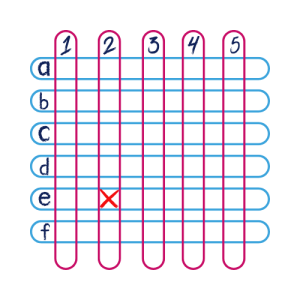

When you put these two things together – a specific WHO and a clearly articulated WHAT – and you have the foundation of a niche that can actually do the job it’s supposed to do. Not as a label to put on a website, but as a practical tool for knowing where to show up, what to say when you get there, and who you’re saying it to. That’s what makes a niche useful rather than decorative, and it’s where the Nail Your Niche challenge begins.
An Opportunity
If you’d like to understand more about how to choose a niche, may I offer you a way to learn a bit more for free? Why not join my next free challenge, Nail Your Niche?
We run it several times a year and there’s even an option to upgrade to a VIP version, which gives you 3 x 60-minute group mentoring sessions with me for just £99 (inc VAT) – that provides us with time for a lot of robust conversations about how ethical marketing works.